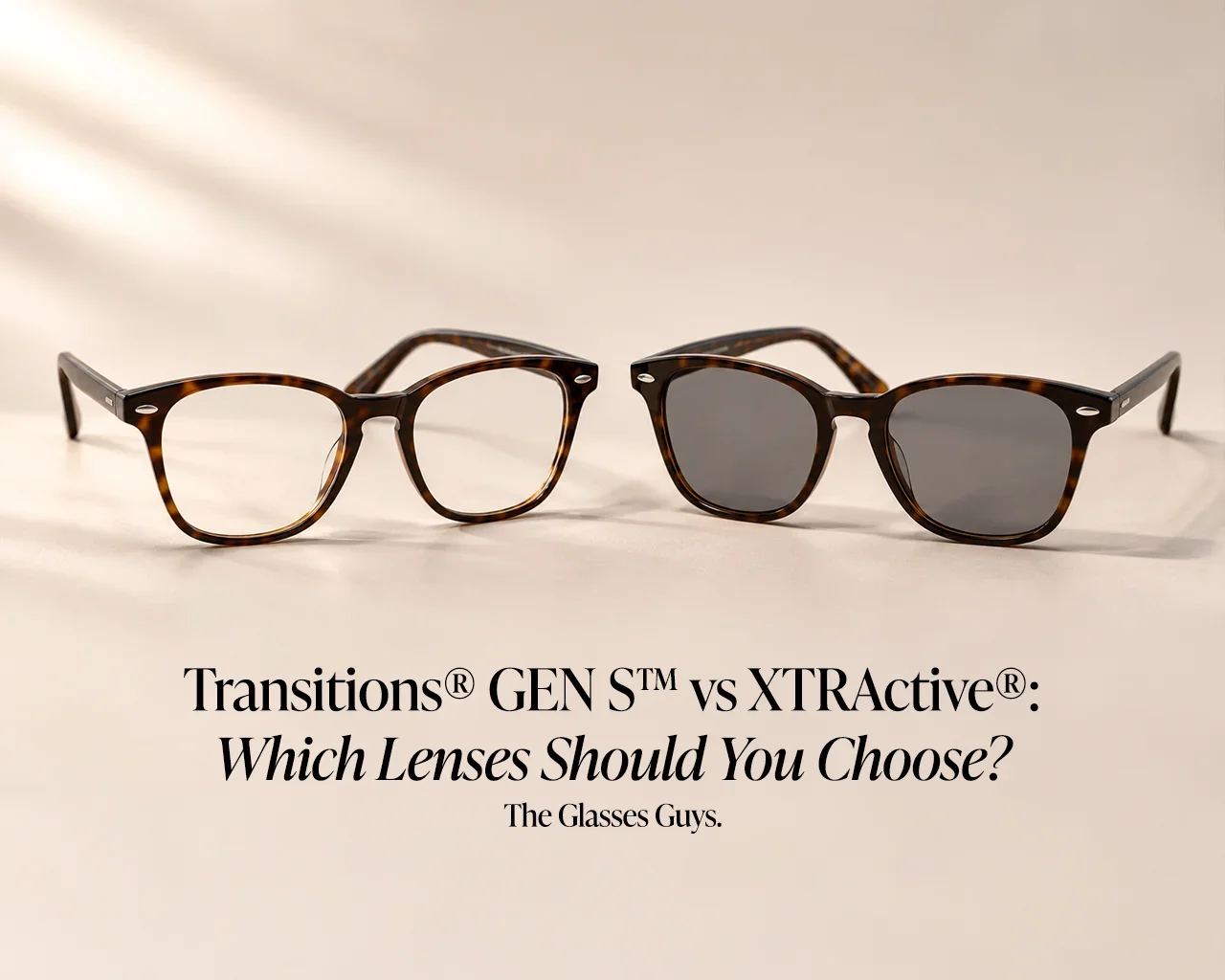
If you're considering Transitions® lenses for your glasses, you've probably come across two popular options: Transitions® GEN S™ and Transitions® XTRActive® new generation.
Both are photochromic lenses that darken automatically as the light changes. Both can be made to your prescription, and both give you glasses that adapt throughout the day.
But there's an important difference.
GEN S is designed for everyday convenience, with fully clear lenses indoors and very fast adaptation to sunlight. XTRActive is designed for people who want extra darkness outdoors, some darkening behind a car windscreen and extra protection from bright light.
So which should you choose?
In this guide, we compare their darkness, indoor clarity, driving performance, colour options and everyday comfort. We also explain how you can upgrade the glasses you already own with Transitions® lenses.
GEN S vs XTRActive: Quick Comparison
| Feature | Transitions® Gen S | Transitions® XTRActive |
|---|---|---|
| Best suited to | Everyday wear | Bright light and greater light sensitivity |
| Appearance indoors | Fully clear | Clear with a slight residual tint |
| Darkness outdoors | Dark, reaching category 3 in specified test conditions | Extra dark |
| Darkening inside a car | Generally minimal | Yes, some activation |
| Return towards clear | Particularly fast | Generally slower than Gen S |
| Standard colours | 8 colours | Grey, brown and graphite green |
| UV protection | 100% UVA and UVB blocking | 100% UVA and UVB blocking |
| Polarised? | No | No, but a separate XTRActive Polarized product exists |
| Prescription options | Available | Available |
The simple answer: choose GEN S if you want lenses that look clear indoors and react quickly as you move between inside and outside. Choose XTRActive if you want darker lenses outdoors, or some darkening while you drive.
What Are Transitions® GEN S™ Lenses?
GEN S is Transitions' everyday photochromic lens. It balances indoor clarity, outdoor darkness and fast responsiveness.
Like other Transitions® lenses, it darkens when exposed to UV light outdoors and returns to clear when you go back inside. What sets GEN S apart is speed.
In Transitions Optical's laboratory testing, GEN S lenses reach category 3 sunglass darkness in about 25 seconds and fade back to clear in under two minutes. Real-world performance varies with temperature, UV levels, lens material and colour.
Key benefits of GEN S
Fully clear indoors: looks like a standard clear prescription lens inside.
Fast activation: darkens within seconds in outdoor light.
Fast fade-back: returns to clear quickly when you come indoors.
Eight colours: a wide choice of classic and contemporary tints.
UV protection: blocks 100% of UVA and UVB rays.
GEN S suits people who move between indoors and outdoors often and want one pair of glasses that keeps up. Whether you're commuting, shopping or out walking, it saves switching between clear glasses and prescription sunglasses.
What Are Transitions® XTRActive® Lenses?
XTRActive is designed for people who want extra darkness and light protection, especially in bright conditions.
Where GEN S focuses on indoor clarity and speed, XTRActive prioritises darkness and performance in challenging light.
One of its biggest advantages is that it can darken behind a car windscreen. Most windscreens block the UV light that activates standard photochromic lenses. XTRActive also reacts to some visible light, so it can activate inside a car.
Key benefits of XTRActive
Extra darkness outdoors: darker than standard everyday photochromic lenses in bright sun.
Some activation while driving: can darken behind a windscreen.
Made for bright conditions: useful if strong sunlight makes you uncomfortable.
UV protection: blocks 100% of UVA and UVB rays.
Wearable all day: fine indoors, although a slight tint remains.
XTRActive may suit you if you spend a lot of time outdoors, drive often in daylight or want lenses that go especially dark in sunshine.
The trade-off is that XTRActive isn't as completely clear indoors as GEN S.
Which Gets Darker: GEN S or XTRActive?
If outdoor darkness is your priority, XTRActive is generally the better choice.
GEN S reaches category 3 sunglass darkness in test conditions, which makes it a strong everyday option outdoors. XTRActive is engineered to go darker still, and to hold that darkness better in hot weather. That can make a noticeable difference if you spend long periods in bright sun.
Does temperature affect Transitions® lenses?
Yes. Photochromic lenses generally get darker in cool conditions and may not reach the same darkness in very hot weather.
XTRActive is designed to perform better in heat than standard clear-to-dark lenses. That makes it a good fit for sunny holidays and summer days out.
Neither lens is a complete replacement for dedicated sunglasses in every situation. For intense sun, such as skiing, beach days or long spells of glare, prescription sunglasses may still be the better choice.
Do GEN S and XTRActive Work in the Car?
This is one of the biggest differences between the two.
GEN S while driving
GEN S lenses don't darken much behind a typical windscreen, because the glass blocks most of the UV light that activates them. So GEN S may stay fairly clear while you drive, even on a sunny day. If you drive a lot in bright daylight, bear this in mind.
XTRActive while driving
XTRActive reacts to some visible light as well as UV, so it can darken behind a windscreen. That makes it the better choice if you want light-responsive prescription lenses that give some extra tint while driving.
How dark they get depends on your car's glass, the light, the temperature and the lens itself.
Important: XTRActive won't get as dark in the car as it does outdoors. If driving comfort is your main concern, prescription sunglasses or Transitions® Drivewear®, a lens designed specifically for driving, may suit you better.
Lenses that are too dark are not suitable for night driving. Always follow the manufacturer's driving guidance.
Which Lenses Return to Clear Faster?
GEN S is the stronger choice if fast fade-back matters to you.
It's built for quick changes between indoors and outdoors. In manufacturer testing, it fades back to clear in under two minutes. That helps if you're in and out all day, for example popping out at lunch and wanting your glasses clear again as soon as you're back at your desk.
XTRActive lenses also lighten indoors. Because they're built for extra darkness and keep a slight tint, the experience is different.
If you want your glasses to look as close as possible to ordinary clear lenses indoors, GEN S is likely to suit you better.
Do XTRActive Lenses Have a Tint Indoors?
Yes, and it's worth knowing before you choose.
GEN S lenses are designed to be fully clear indoors. XTRActive lenses keep a subtle tint even without strong outdoor light. The tint is intentional and is part of how the lens manages bright light.
Some wearers like it, especially if bright indoor lighting bothers them. Others prefer the completely clear look of GEN S. Neither is better as such. It depends on how you want your glasses to look and feel.
If you prefer the look of traditional clear glasses indoors, GEN S is the more natural choice.
GEN S Colours vs XTRActive Colours
Lens colour changes the whole look of your glasses, especially if you plan to keep your frames for years.
GEN S colours
GEN S comes in eight colours:
Grey
Brown
Graphite Green
Sapphire
Amethyst
Amber
Emerald
Ruby
Grey and brown are versatile classics, while sapphire, emerald and ruby give a more distinctive look.
XTRActive colours
XTRActive new generation comes in three core colours:
Grey
Brown
Graphite Green
XTRActive is also available with Style Mirrors finishes in selected configurations.
If colour choice matters most to you, GEN S has the wider range. Availability depends on lens material, prescription and supplier.
Are XTRActive Lenses Polarised?
Standard XTRActive lenses are not polarised.
There is a separate lens called Transitions® XTRActive® Polarized. It combines photochromic darkening with polarisation that increases as the lens darkens, to help cut reflected glare outdoors. It partly activates behind a windscreen too, but it isn't classed as polarised there.
Don't confuse the two when comparing options. If reducing glare from roads, water or wet surfaces is a priority, polarised prescription sunglasses or XTRActive Polarized are worth considering.
Are GEN S or XTRActive Better for Everyday Wear?
For most people who want a convenient everyday photochromic lens, GEN S is the best place to start. Its indoor clarity, fast darkening, quick fade-back and colour choice make it very versatile.
XTRActive may suit some lifestyles better.
Choose GEN S if you:
Want your glasses to look fully clear indoors.
Move between indoors and outdoors often.
Want fast changes between clear and dark.
Want a wider choice of lens colours.
Mainly need light-responsive lenses for everyday life.
Choose XTRActive if you:
Want darker lenses in bright conditions.
Are more sensitive to bright light.
Want some darkening while driving.
Spend a lot of time outdoors.
Don't mind a slight tint indoors.
Can You Have Transitions® Lenses With Your Prescription?
Yes. Transitions® technology can be combined with a range of prescription lens designs, subject to availability:
Single vision: for distance, reading or intermediate prescriptions.
Varifocal: distance, intermediate and near vision in one lens, with photochromic darkening.
Bifocal: available in selected combinations, depending on your prescription and lens design.
Different lens materials and thicknesses are also available. If you have a stronger prescription, thinner high-index lenses can improve the look and comfort of your glasses. What's available depends on your prescription and the lens you choose.
Can You Put GEN S or XTRActive Lenses Into Existing Frames?
Yes, as long as your frames are suitable for reglazing.
You don't need to buy a new pair of glasses to get Transitions® lenses. If you already have frames you love, you can often replace the lenses with new prescription photochromic ones. This is called reglazing or relensing.
At The Glasses Guys, we specialise in fitting new prescription lenses into customers' existing frames. Whether your prescription has changed, your lenses are scratched or you simply want light-responsive lenses, reglazing is a practical alternative to a complete new pair.
Depending on your prescription and frame, you can choose GEN S or XTRActive. You keep the frames you enjoy wearing and upgrade the lenses to suit your lifestyle.
What Affects the Cost of GEN S and XTRActive Lenses?
The price of Transitions® lenses depends on:
Your prescription
Single vision or varifocal design
Lens material and thickness
Which Transitions® lens you choose
Extra coatings or finishes
Whether you're buying new glasses or reglazing your own frames
XTRActive usually costs more than everyday photochromic options, although prices vary between suppliers.
It's worth comparing the complete specification rather than the lens technology alone. For example, a strong prescription in thin varifocal lenses will cost considerably more than standard single vision lenses.
If your frames are still in good condition, reglazing means you pay for the new lenses only, not a whole new pair.
GEN S vs XTRActive: Our Verdict
Both are strong photochromic lenses, built for different priorities.
For everyday convenience, indoor clarity and fast responsiveness, we'd suggest considering GEN S first. It's ideal if you want glasses that look clear indoors, darken quickly outside and come in a wide choice of colours.
For more outdoor darkness, sensitivity to bright light and some darkening behind a windscreen, XTRActive is worth considering. Its extra darkness suits people who spend a lot of time in bright conditions.
The best choice depends on your prescription, lifestyle and preferences. And whichever you choose, you may not need to replace your frames.
Upgrade Your Existing Glasses With Transitions® Lenses
Love your current glasses but wish they adapted to changing light?
At The Glasses Guys, we help customers across the UK refresh their favourite frames with new prescription lenses, from everyday single vision to varifocals. If your frames are suitable, Transitions® lenses can give them a new lease of life without buying a new pair.


❓ Frequently Asked Questions
-
GEN S is generally better for everyday wear if you want fully clear lenses indoors and fast responsiveness. XTRActive suits people who want extra darkness outdoors and some darkening while driving.
-
Yes. XTRActive is designed to go extra dark in bright conditions, including hot weather. Actual darkness depends on temperature, light, lens material and colour.
-
GEN S lenses don't darken much behind a typical windscreen, because the glass blocks most of the UV light that activates them. XTRActive also reacts to some visible light, so it offers some darkening while driving.
-
XTRActive lenses are clear with a slight protective tint indoors. GEN S lenses are designed to be fully clear indoors.
-
In manufacturer tests, GEN S lenses reach category 3 darkness in about 25 seconds and fade back to clear in under two minutes. Real-world performance varies with conditions and lens specification.
-
Yes. Transitions® lenses are available in selected varifocal designs, giving distance, intermediate and reading correction with light-responsive performance.
-
Standard XTRActive lenses are not polarised. Transitions® XTRActive® Polarized is a separate lens that adds polarisation outdoors.
-
Yes. If your frames are suitable for reglazing, your lenses can be replaced with new prescription Transitions® lenses without buying a new pair of glasses.